
Antithesis
Antithesis Napa Valley
While respecting tradition, innovation is in our DNA, and our experimental lot wines are a testament to this philosophy. As a winemaker unbound by classical training, I embrace a world of endless possibilities, where creativity knows no bounds. This freedom allows me to explore, imagine, and take bold risks, crafting wines that transcend traditional boundaries.
Lisa Perrotti-Brown, the lead critic for The Wine Advocate at the time—and arguably the #1 wine critic in the world—wrote these words about Antithesis:
“In a word: WOW. At first, I didn’t understand this somewhat cryptic, out-of-the-box winemaking concept by the gifted winemaker Jason Moore, but I have truly seen the method to his madness. He’s clearly a mad genius, because Antithesis is mind-blowingly good!”
Our experimental lot wines, like Antithesis and Center of Gravity, are born from a desire to push the envelope and redefine what wine can be. Each bottle is a cerebral journey, a unique expression of liquid art that stands apart in the wine world. These creations are not just wines; they are a celebration of creativity, daring, and the pursuit of the extraordinary. I truly hope that when I’m long gone, these wines will be a testament to the legacy and impact on the wine industry that I’m remembered for.
Only 75-100 cases are produced annually.
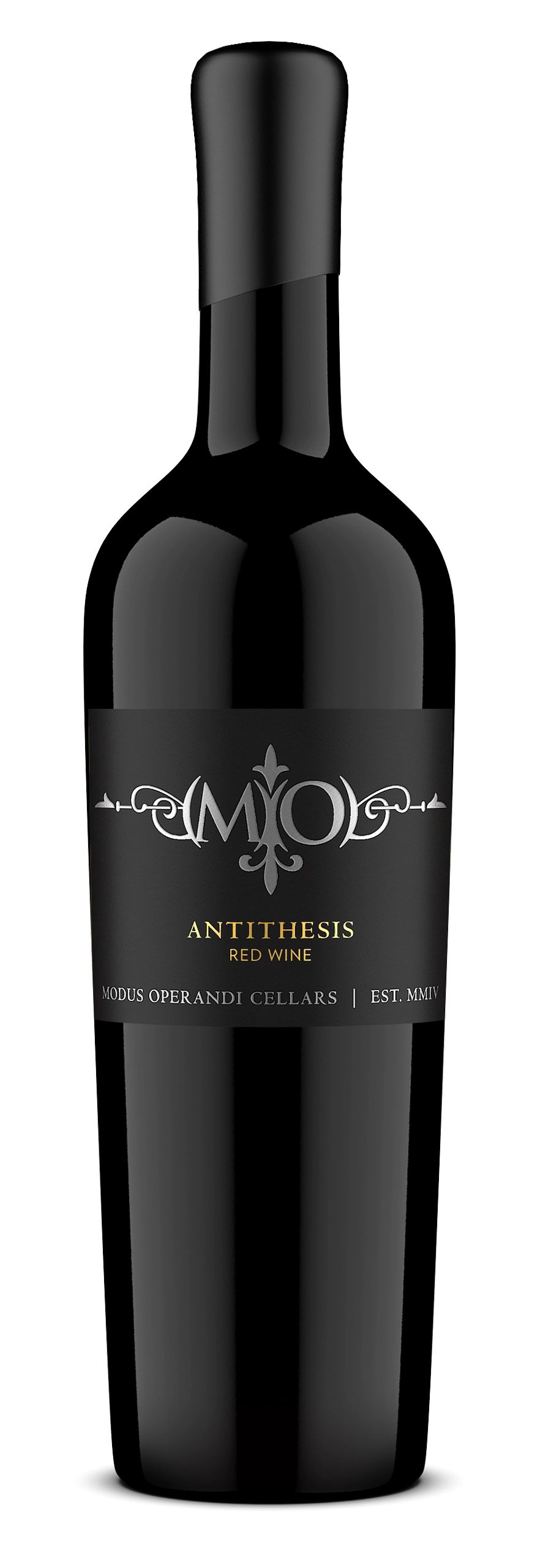
Antithesis Napa Valley
- 2023 - 98 Points
- 2022 - 97 Points
- 2021 - 98 Points
- 2019 - 97 Points
- 2018 - 98 Points
- 2016 - 92 Points
- 2015 - 92 Points
- 2014 - 90 Points
Today we make Antithesis
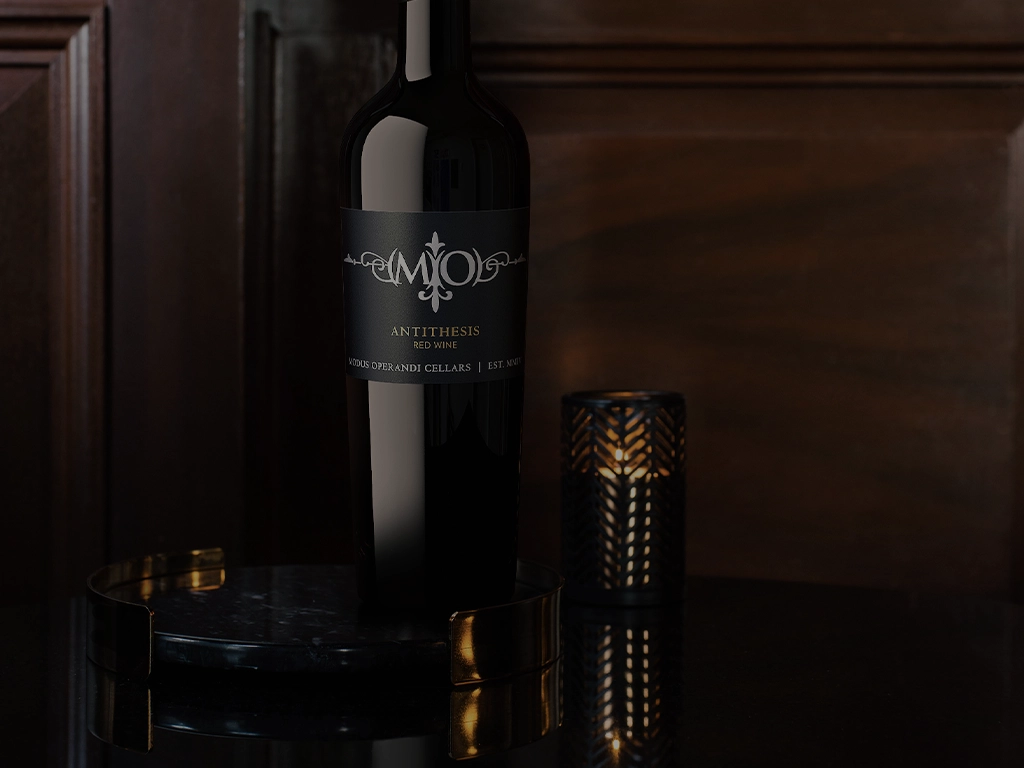
Antithesis: The Legacy Wine of Modus Operandi Cellars
For nearly two decades, I’ve been known as “the Cabernet guy.” My Napa Valley Cabernets have consistently scored alongside the best of the best—97s, 98s, even brushing the edge of perfection as defined by critics. But as proud as I am of those wines (and my Sonoma Coast Pinot Noirs that have earned their own accolades), they aren’t the wines I want to be remembered for.
That distinction belongs to Antithesis.
This isn’t just another bottle in my portfolio—it’s my fingerprint, my signature, the wine that tells my story as a winemaker. It’s a wine no one else on earth makes because it’s built on a technique that I invented, refined, and obsessed over for 20 years.
Born of Necessity: A Rule-Breaking Accident
The story begins in 2006 with every winemaker’s nightmare: a stuck fermentation. The yeast quit halfway, leaving behind a sweet, unfinished wine. Textbook winemaking tells you to fix it with a lab solution—reinoculate with new yeast and hope for the best.
But instead, I gambled. I pressed the unfinished Merlot away from its exhausted skins and married it with a tank of Petite Sirah skins that were still full of life.
By every conventional rule, this shouldn’t have worked. Different varietals. Different timing. An outright heresy. And yet—it created something extraordinary.
Petite Sirah, angular and architectural like a cube, collided with Merlot, supple and spherical like a sphere. Together, they formed a paradox in balance: structure softened into elegance, power transformed into grace.
That first vintage revealed not just a solution but a new philosophy: sometimes the greatest art comes from refusing to follow the rules.
Reverse Saignée: An Innovation in Winemaking
Tradition has a French name for concentration: Saignée. It’s the practice of bleeding juice from a fermenting tank, leaving more skins behind to intensify flavor and color.
Antithesis flips that idea on its head. Instead of taking juice away, I add skins. I call it Reverse Saignée.
Here’s how it works today:
-
Harvest: Petite Sirah and Merlot are picked the same day.
-
Sacrifice: The Petite Sirah is pressed immediately. Its juice is discarded “sacrificial”. Its skins—the purest vessel of color and tannin—are saved.
-
Union: The Merlot, freshly harvested, is pumped into tank, and those Petite Sirah skins are shoveled in alongside it. The ratio becomes extraordinary: 1 part Merlot skins, 1 part Petite Sirah skins, to just 1 part Merlot juice. Twice the skins. Pure concentration.
-
Aging: Only the free-run juice is saved, then aged 22 months in 100% Sylvain Grand Reserve French oak.
-
Blending: In some vintages, I introduce up to 20% Cabernet Sauvignon for depth, but at its core, Antithesis is neither Merlot nor Petite Sirah—it’s something entirely new.
This method doesn’t exist anywhere else in the world. It’s mine alone. And it produces a wine unlike any other.
A Tactile Experience: How Antithesis Tastes
I often describe Antithesis in shapes:
-
Petite Sirah is a cube—angular, structured, forceful.
-
Merlot is a sphere—round, supple, elegant.
-
Together, they create liquid geometry: a cube wrapped in a sphere.
The result is both cerebral and sensual. Antithesis is dense, dark, and structured, yet also velvety and graceful. It makes you pause, think, and feel. It is not just tasted, but experienced.
Recognition: At Last, The Critics Understand
For years, Antithesis was my quiet obsession, made in tiny volumes—often no more than four barrels (about 1,200 bottles). But eventually, recognition arrived:
-
2018 Vintage: 98 points
-
2019 Vintage: 97 points
-
2021 Vintage: 98 points
- 2022 Vintage: 96+ points
- 2023 Vintage: ?? Best YET
And then came words I’ll never forget, from Lisa Perrotti-Brown, former lead critic for The Wine Advocate:
“In a word: WOW. At first, I didn’t understand this somewhat cryptic, out-of-the-box winemaking concept by the gifted winemaker Jason Moore, but I have truly seen the method to his madness. He’s clearly a mad genius, because Antithesis is mind-blowingly good!”
My Legacy in a Glass
Cabernet will always define Napa. Pinot Noir will always find brilliance in Sonoma. And I will continue to craft those wines at the highest level. But my contribution to the wine world isn’t about making a better Cabernet or Pinot. It’s about creating something new.
Antithesis is that creation. It’s my innovation. My art. My paradox in balance. My legacy.
When I’m gone, this is the wine I want people to remember me by.